Choose layout
Choose font
Size
Print options
final squat video
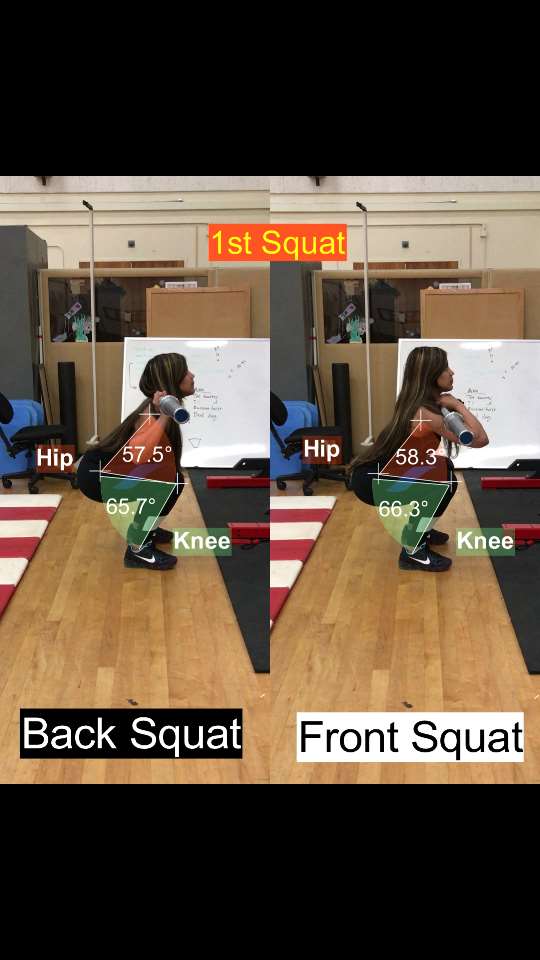
Joint Motions and Angular Displacement
Three key joint motions shown in both types of squats are the hip, knee, and ankle flexion in the sagittal plane during the first phase or eccentric phase. (controlling gravity)
The two angles of hip flexion in the two types of squats are relatively the same. The Back Squat is 57.5 degrees and Front Squat=58.3.
The two angles of knee flexion in the two types of squats are also relatively the same. The Back Squat is 65.7 degrees and the front squqat is 66.3 degrees.
Angular displacement is defined as the change of angles of a joint in a specific motion from beginning to end.
The beginning of the back squat during the hip flexion motion, the angle starts at 57.5 degrees. The angle of knee flexion starts at 65.7 degrees.
The beginning of the front squat during the hip flexion motion, the angle starts at 58.5 degrees. The angle of knee flexion starts at 66.3 degrees.
The two angles of hip flexion in the two types of squats are relatively the same. The Back Squat is 57.5 degrees and Front Squat=58.3.
The two angles of knee flexion in the two types of squats are also relatively the same. The Back Squat is 65.7 degrees and the front squqat is 66.3 degrees.
Angular displacement is defined as the change of angles of a joint in a specific motion from beginning to end.
The beginning of the back squat during the hip flexion motion, the angle starts at 57.5 degrees. The angle of knee flexion starts at 65.7 degrees.
The beginning of the front squat during the hip flexion motion, the angle starts at 58.5 degrees. The angle of knee flexion starts at 66.3 degrees.
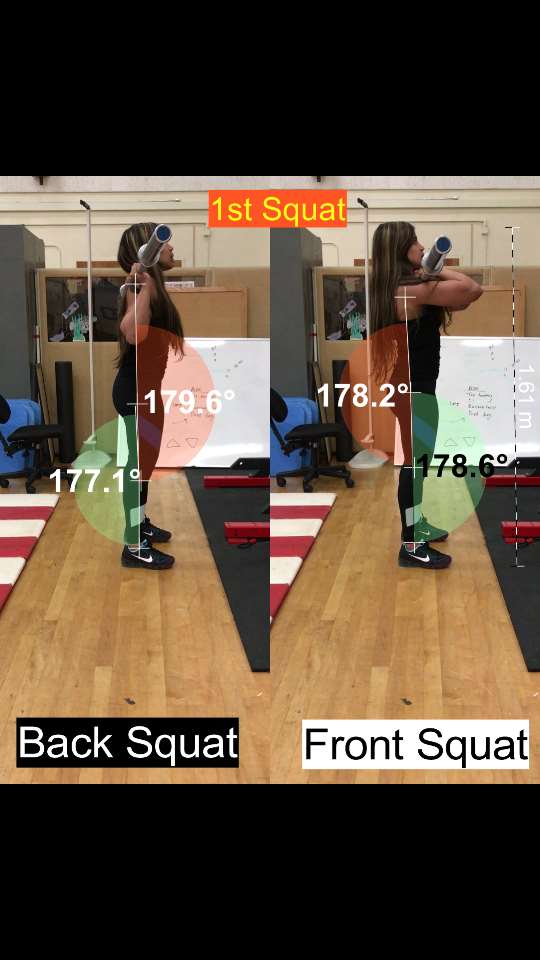
Joint Motions & Angular displacement
During the 2nd phase or concentric phase (going against gravity), the joint motions are completed with knee, hip, and ankle extension in the sagittal plane. The ending of the squat the angles of the knee extension of the back squat is 177.1 degrees. The hip extension angle of the back squat is 179.6 degrees. The ending of the squat the angle of the knee extension of the back squat is 178.6 degrees. The hip extension angle of the front squat is 178.2 degrees.
To calculate angular displacement:
Final angle-initial angle.
The angular displacement of the hip during the back squat follows:
179.6 degrees-57.5 degrees= 122.1 degrees
The angular displacement of the knee during the back squat follows:
177.1 degrees-65.7 degrees=111.4 degrees
The angular displacement of the hip during the front squat:
178.2 degrees-58.3 degrees=119.9 degrees
The angular displacement of the knee during the back squat:
178.6 degrees-66.3 degrees= 112.3 degrees
To calculate angular displacement:
Final angle-initial angle.
The angular displacement of the hip during the back squat follows:
179.6 degrees-57.5 degrees= 122.1 degrees
The angular displacement of the knee during the back squat follows:
177.1 degrees-65.7 degrees=111.4 degrees
The angular displacement of the hip during the front squat:
178.2 degrees-58.3 degrees=119.9 degrees
The angular displacement of the knee during the back squat:
178.6 degrees-66.3 degrees= 112.3 degrees
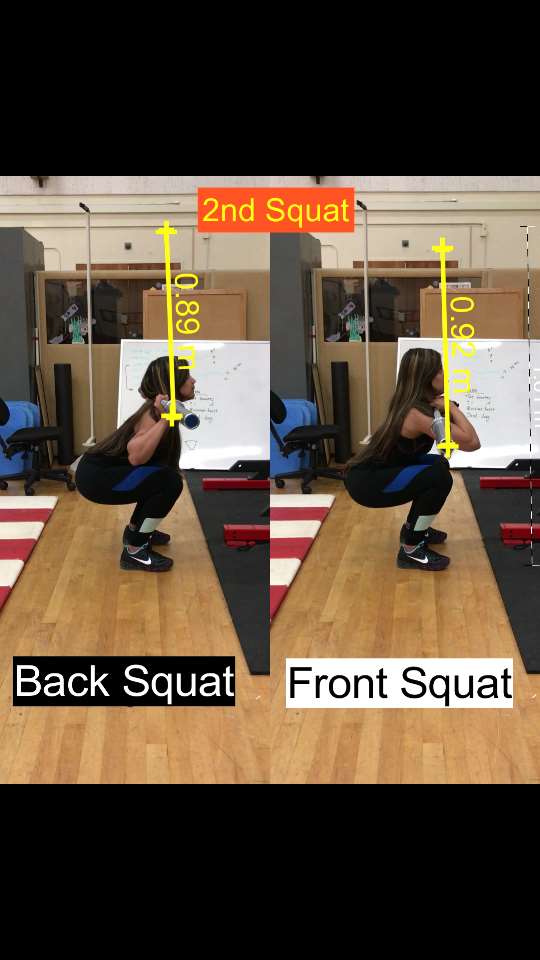
Linear Displacement
Displacement is the shortest distance that the person travels.
The distance that the subject traveled while doing a squat was relatively the same in both types of squats.
Back Squat: 0.89 m
Front Squat: 0.92 m
The distance that the subject traveled while doing a squat was relatively the same in both types of squats.
Back Squat: 0.89 m
Front Squat: 0.92 m
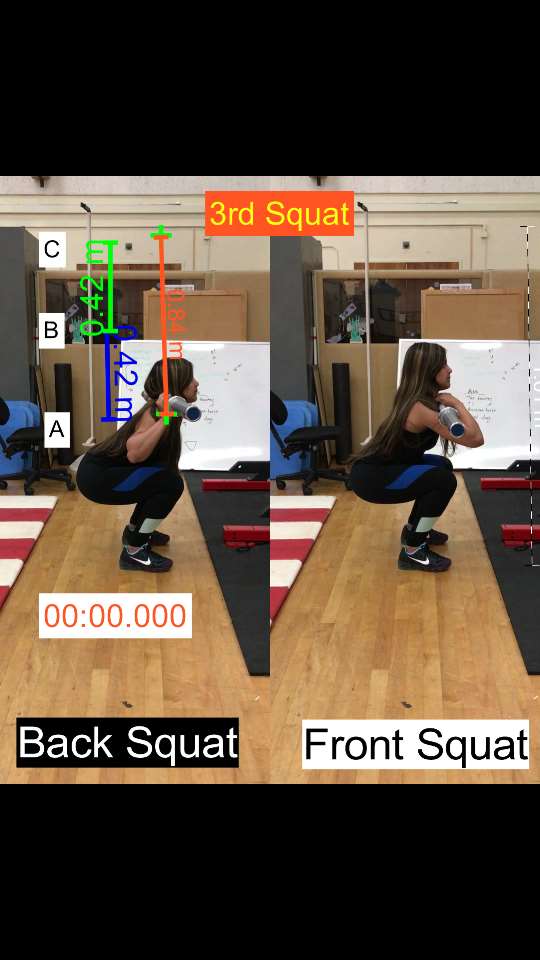
Linear Acceleration of the Back Squat
Acceleration is defined as the rate of change of velocity that an object or person travels.
To calculate acceleration:
delta Velocity/ time
Unit: m/s^2
Velocity of point A to point B:
0.42m/.766 s=.548 m/s
Velocity of point B to point C:
0.42m/.734 s=.572 m/s
Acceleration:
.572 m/s-.548 m/s/1.5 s=0.016 m/s^2
The subject showed signs of acceleration during her back squat due to calculations.
To calculate acceleration:
delta Velocity/ time
Unit: m/s^2
Velocity of point A to point B:
0.42m/.766 s=.548 m/s
Velocity of point B to point C:
0.42m/.734 s=.572 m/s
Acceleration:
.572 m/s-.548 m/s/1.5 s=0.016 m/s^2
The subject showed signs of acceleration during her back squat due to calculations.
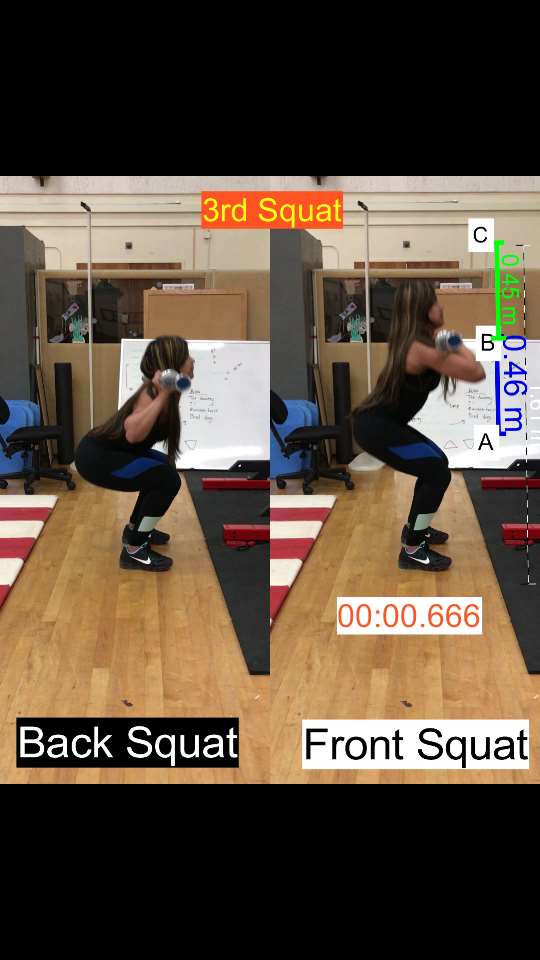
Acceleration of Front Squat
Velocity from point A to point B:
0.46m/.666s=.690 m/s
Velocity from point B to point C:
0.45 m/.8 s=0.563 m/s
Acceleration: 0.563-.690/1.433=-0.089 m/s^2
The subject showed signs of negative acceleration in the back squat, which means she slowed down during the front squat.
0.46m/.666s=.690 m/s
Velocity from point B to point C:
0.45 m/.8 s=0.563 m/s
Acceleration: 0.563-.690/1.433=-0.089 m/s^2
The subject showed signs of negative acceleration in the back squat, which means she slowed down during the front squat.
Linear Velocity of the Squat Ascent
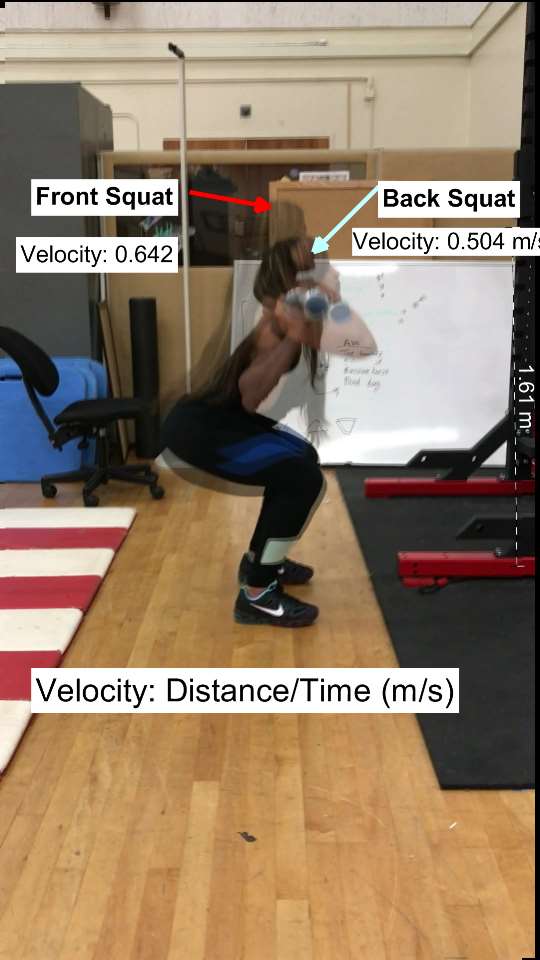
Linear Velocity is the speed that an object/person travels in a straight motion.
To calculate velocity:
Velocity: Distance/Time
Unit- m/s
Back Squat:
Velocity: 0.89 m/1.8 s= 0.494 m/s
Front Squat:
Velocity: 0.92 m/1.433 s=.642 m/s
Based upon calculations, the subject completed the first squat of the front squat at a higher velocity than the back squat.
According to an article, a proper squat involves in descending the hips first while the posture is upright at a controlled speed during the eccentric phase with no less than 2:1 up to 4:1 ratio (descend:ascend). There has been observation that athletes beginning to learn how to squat are inclined to have a quick velocity, which could lead to muscles stretching too quickly and could lead to an injury. The article also states that if the athlete is not dropping his or her hips first, then the athelets are shifting the load towards the anterior knee. This could result in shear forces on the anterior knee. During the concentric phase, a proper squat is required to not have the hips extend faster than the shoulder. The proper form is to keep the hips and shoulder aligned and moved at a proper pace and at the same time.
Analyzing this subject in the video shows that she has a controlled pace in each squat she completes. Her hips are shown to flex first as well. Her frontal squat showed a slightly higher velocity than the back squat which could lead to the idea that she may have had more power in the frontal squat.
REFERENCE
The back squat: A proposed assessment of functional deficits and technical factors that limit performance. Myer GD, Kushner AM, Brent JL, Schoenfeld BJ, Hugentobler J, Lloyd RS, Vermeil A, Chu DA, Harbin J, McGill SM. Strength Cond J. 2014 Dec 1;36(6):4-27.
To calculate velocity:
Velocity: Distance/Time
Unit- m/s
Back Squat:
Velocity: 0.89 m/1.8 s= 0.494 m/s
Front Squat:
Velocity: 0.92 m/1.433 s=.642 m/s
Based upon calculations, the subject completed the first squat of the front squat at a higher velocity than the back squat.
According to an article, a proper squat involves in descending the hips first while the posture is upright at a controlled speed during the eccentric phase with no less than 2:1 up to 4:1 ratio (descend:ascend). There has been observation that athletes beginning to learn how to squat are inclined to have a quick velocity, which could lead to muscles stretching too quickly and could lead to an injury. The article also states that if the athlete is not dropping his or her hips first, then the athelets are shifting the load towards the anterior knee. This could result in shear forces on the anterior knee. During the concentric phase, a proper squat is required to not have the hips extend faster than the shoulder. The proper form is to keep the hips and shoulder aligned and moved at a proper pace and at the same time.
Analyzing this subject in the video shows that she has a controlled pace in each squat she completes. Her hips are shown to flex first as well. Her frontal squat showed a slightly higher velocity than the back squat which could lead to the idea that she may have had more power in the frontal squat.
REFERENCE
The back squat: A proposed assessment of functional deficits and technical factors that limit performance. Myer GD, Kushner AM, Brent JL, Schoenfeld BJ, Hugentobler J, Lloyd RS, Vermeil A, Chu DA, Harbin J, McGill SM. Strength Cond J. 2014 Dec 1;36(6):4-27.

Cal State East Bay TV
powered by
dartfish.tv
Squat_Amazzarini
This video will explain the kinematic variables of the back and frontal squats. It will also describe and explain how the linear velocity and acceleration is different from the two types of squats. The calculations will be shown to explain how the variables are different. In addition, the video will explain joint motions and angular displacement of the joints.
Note: Reference distance is the subjects height (1.61 m)
Note: Reference distance is the subjects height (1.61 m)